
The Booking Is Not the Revenue Forecast: Expected Usage, Actual Usage, and Recognition Rules
The CRM says a deal closed for $500,000. Finance asks a different question: how much revenue will the business recognize next month?
That question sounds simple until the contract includes a subscription, implementation services, a usage component, and a one-time fee. Each element may have a different value source, service period, and recognition pattern. The customer’s actual usage may not match the commercial expectation. The allocated transaction price may not match the amount written beside each item on the order form.
The booking is real. It is still not the revenue forecast.
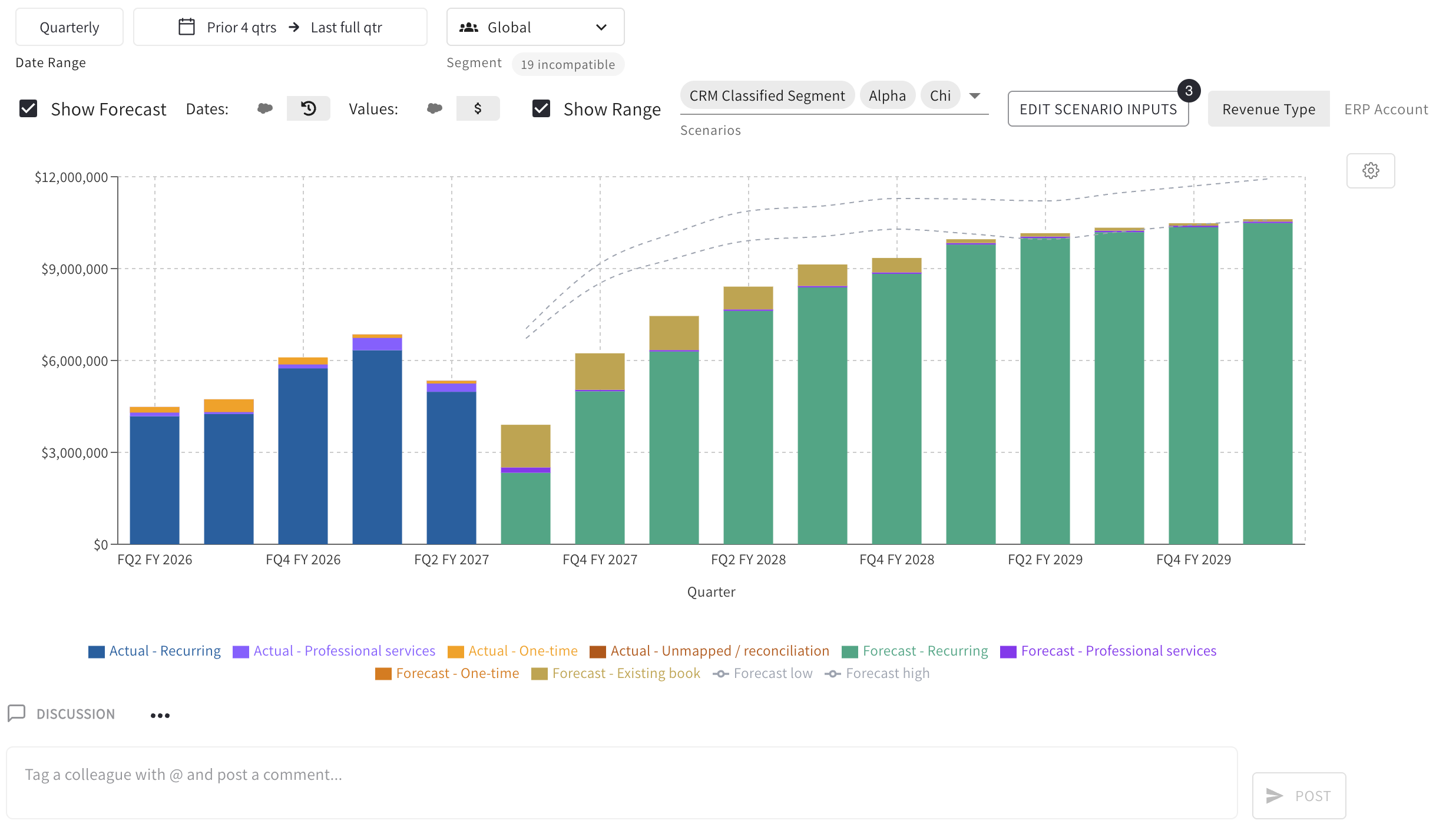
The spreadsheet bridge is where confidence goes to die
Most forward revenue models begin in systems built for other jobs.
The CRM holds opportunities, expected values, close dates, renewals, and sales stages. CPQ holds products, quote lines, quantities, discounts, and service dates. Billing records what was invoiced. The general ledger records what finance recognized. None of those systems, by itself, answers the full forward-revenue question.
So finance builds a bridge. A booking export lands in one tab. Contract schedules land in another. Someone adds assumptions for usage, services, and renewals. Actuals are pasted over prior estimates after close. The workbook becomes important enough that nobody wants to replace it and fragile enough that nobody fully trusts it.
The problem is not a missing total. It is a missing translation that can be run the same way every time.
A booking is an event; revenue is a schedule
A sales booking records a commercial event. Revenue describes when the company earns the value associated with that event.
For a simple annual subscription, $120,000 of ARR may become $10,000 of recurring revenue each month across the service term. An implementation fee may be recognized during a three-month delivery window. Hardware may be recognized in the delivery month. Usage revenue may depend on what the customer actually consumes.
That means a forecast must preserve more than the booking amount. It needs to preserve the business logic attached to the booking:
- Which revenue stream does the value belong to?
- Is there a known value on the opportunity or quote line?
- When does service begin and end?
- Is recognition continuous, same-month, or straight-line?
- What assumption applies if a future cohort does not yet have deal-level detail?
- What portion belongs to contracts already signed rather than future pipeline?
QFlow Revenue Agent carries those decisions from the sales scenario into the monthly revenue schedule.
Expected usage value is not actual usage value
Usage businesses introduce a second translation problem. The commercial plan may contain expected users, transactions, activations, API calls, or another unit. Revenue depends on how many units materialize, what portion is billable, and the realized price.
A useful expected-value model makes those drivers explicit:
Estimated units × realization rate × price per unit
The assumptions may be global, segment-specific, or shaped by contract month. A newly signed cohort may ramp differently from a mature customer. A price may come from a known CRM or CPQ field for one deal and fall back to a governed assumption for another.
History provides another view. Where invoice detail is available, QFlow can learn the curve of realized invoice dollars relative to booked ARR, TCV, or amount. That makes the expected profile reflect how this business has actually converted bookings into billed revenue instead of imposing a generic straight line.
Actual usage and recognized actuals still have distinct jobs. Operational usage, when retained in a source system, explains what customers consumed; invoice data shows what they were billed for. QFlow’s closed-period authority is mapped accounting data showing what finance posted. As a period closes, QFlow replaces the forecasted period with that mapped accounting actual rather than leaving an estimate in a historical month.
The result is a visible forecast-to-actual handoff, not a silent overwrite.
One contract can contain several recognition rules
Hybrid contracts make one-size-fits-all curves especially dangerous.
Recurring revenue can follow the ARR balance and contract term. Usage can follow units, realization, price, or a learned invoice curve. Professional services can use a known services value and recognize over delivery. One-time or hardware value can land at a point in time. Other business-specific revenue can follow its own configured rule.
QFlow keeps those streams separate. For each stream, a known deal or CPQ value takes priority. If that value is blank, the model can use explicit assumptions. Service and quote-line dates control the schedule when they are present; configured timing is the fallback. Where multiple quote lines have different service periods, line values provide the weights used to distribute the stream across those periods.
Complex revenue recognition rules do not stop at SSP
ASC 606 and IFRS 15 follow the same core sequence: identify the contract and its performance obligations, determine and allocate the transaction price, then recognize revenue when each obligation is satisfied. A business selling usage-based subscriptions and physical products can encounter complexity at every step.
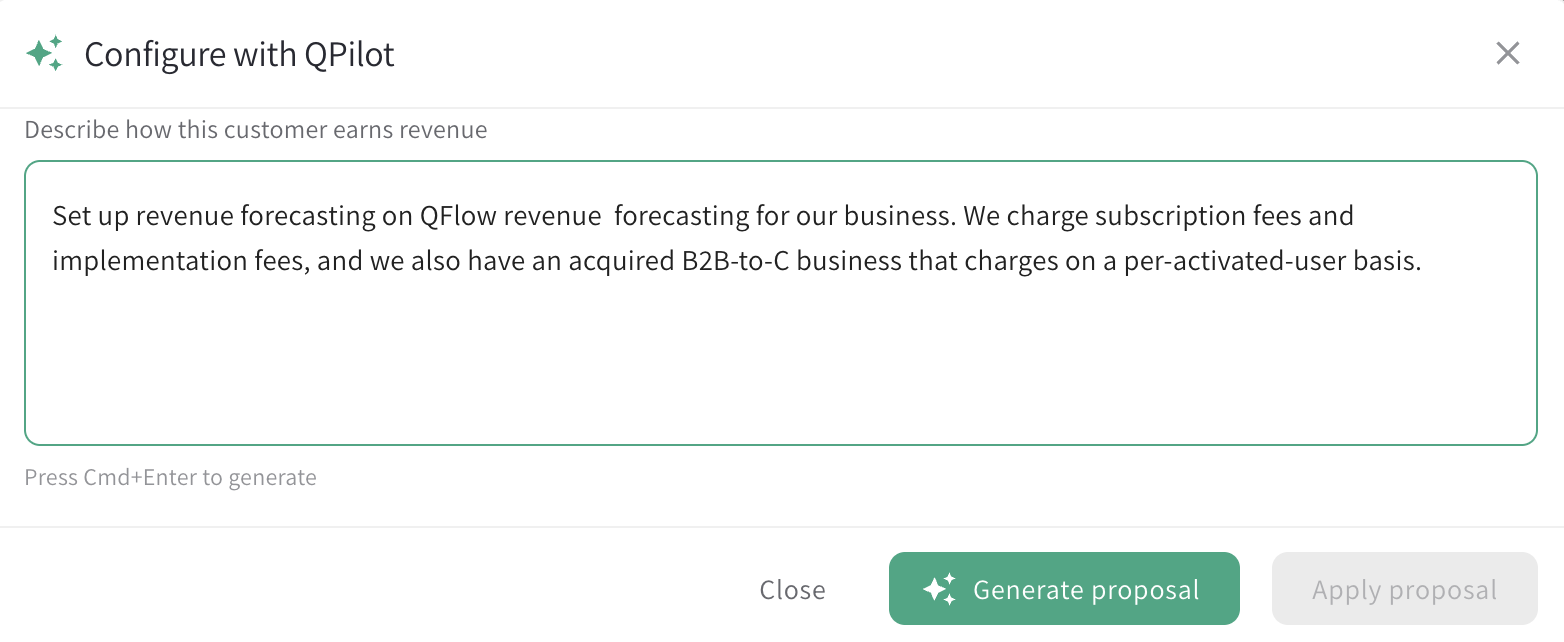
QFlow Revenue Agent handles complex revenue recognition rules, including SSP-based allocations, by carrying governed transaction and quote-line values into stream- and service-date-aware forecast schedules. That lets the forecast reflect the accounting decisions attached to a contract instead of flattening every booking into the same curve.
The rules most likely to matter include:
- Distinct performance obligations and SSP. A bundle may contain software access, implementation, usage, hardware, support, and warranties. The transaction price may need to be allocated across those obligations using relative standalone selling prices rather than contractual line prices.
- Variable consideration. Usage charges, volume tiers, rebates, refunds, service-level credits, price concessions, and performance bonuses can change the expected transaction price. The estimate may use an expected-value or most-likely-amount method and may be constrained to reduce the risk of a significant reversal.
- Point-in-time versus over-time recognition. A subscription or service is commonly recognized over time, while a widget may be recognized when control transfers. Delivery terms, customer acceptance, or a valid bill-and-hold arrangement can affect that point.
- Contract modifications. Upgrades, added units, expansions, downgrades, extensions, and partial terminations can be a separate contract, a prospective change, or a cumulative catch-up depending on the facts and pricing.
- Returns, warranties, and customer options. Return rights can create refund liabilities. A service warranty may be a separate performance obligation. Renewal discounts, prepaid credits, or discounted add-ons can create a material right, while unused prepaid rights can introduce breakage.
- Principal-versus-agent presentation. When third parties provide devices, connectivity, implementation, or marketplace services, the control assessment determines whether revenue is presented gross or net.
- Upfront fees and financing effects. Activation or setup fees are not automatically immediate revenue, and unusual differences between payment and performance timing can introduce a significant financing component.
Accounting policy owners determine the appropriate treatment, allocation, and source-system classifications. QFlow operationalizes those governed outcomes in the forecast: known values take priority, each stream keeps its own timing, contract changes enter the scenario, and posted accounting actuals take over as periods close.
A worked hybrid-contract example
Consider a hypothetical booking with four components:
- $120,000 of annual subscription value, with service beginning in January.
- $30,000 of implementation services delivered from January through March.
- Expected usage of 50,000 units per month, an 80% realization rate, and a price of $0.25 per realized unit.
- A $12,000 hardware charge delivered in February.
Assume the company’s SSP policy and any required relative allocation are already reflected in the source values supplied to the forecast.
The sales scenario records the booking event. The revenue model translates it into schedules:
| Revenue stream | Forecast rule | Illustrative result |
|---|---|---|
| Recurring | $120,000 across the 12-month service term | $10,000 per month |
| Professional services | $30,000 across January–March | $10,000 per month for three months |
| Usage | 50,000 × 80% × $0.25 | $10,000 per month before actuals |
| Hardware | Same-month recognition at delivery | $12,000 in February |
If the customer produces 38,000 billable units in February at $0.25, realized usage value is $9,500 rather than the $10,000 expectation. When February closes, the mapped accounting actual becomes authoritative for that historical period. The original scenario and its assumptions remain available for variance analysis.
The important feature is not the arithmetic. It is that every similar booking follows the same governed translation—from booking, to stream value, to timing, to actual—without rebuilding the logic in a workbook.
The existing book cannot disappear between actuals and pipeline
Future bookings are only part of future revenue. Contracts already signed may still contain months of revenue that have not been recognized.
That existing book includes billed-but-unearned revenue and committed value that has not yet been billed. QFlow keeps it separate from revenue generated by future-booking scenarios. Where invoice schedules are available, the bridge can use them. Where they are not, contract terms can reconstruct the remaining recognition schedule.
Keeping existing-contract revenue separate prevents two common errors: dropping committed revenue from the forecast, or counting it again when future pipeline converts.
Every monthly total should show its work
A finance-ready forecast needs more than a chart. A monthly drilldown should identify:
- The actual accounting rows included in a closed month.
- The existing-contract schedules carried into a forecast month.
- The opportunities and cohorts contributing new recurring, usage, services, or one-time revenue.
- The known source values and fallback assumptions used.
- The recognition method and service period applied.
- Any unmapped accounting value that still needs reconciliation.
That trace is what turns the forecast from a presentation into an operating model. FP&A can update an assumption without losing the source of the number. Finance can distinguish a sales variance from a usage variance or timing variance. Leadership can compare scenarios while knowing that each one passes through the same recognition logic.
The goal is not to make bookings and recognized revenue identical. They are different measures. The goal is to make the translation between them consistent, explainable, and repeatable.
Explore QFlow Revenue Agent to see how QFlow connects booking scenarios, usage assumptions, recognition schedules, existing contracts, and accounting actuals.