
Introducing QFlow Revenue Agent: Forecast Revenue Across Business Models and Entities
A bookings forecast says what may close. A revenue forecast says when and how those bookings become revenue.
The distinction matters. A subscription company recognizes recurring revenue across a contract term. A B2B2C or consumption business depends on usage, realization, and unit price. A hybrid company may add implementation services, hardware, or another one-time charge. Put every stream on the same curve and the top line may look tidy, but it will not describe the business.
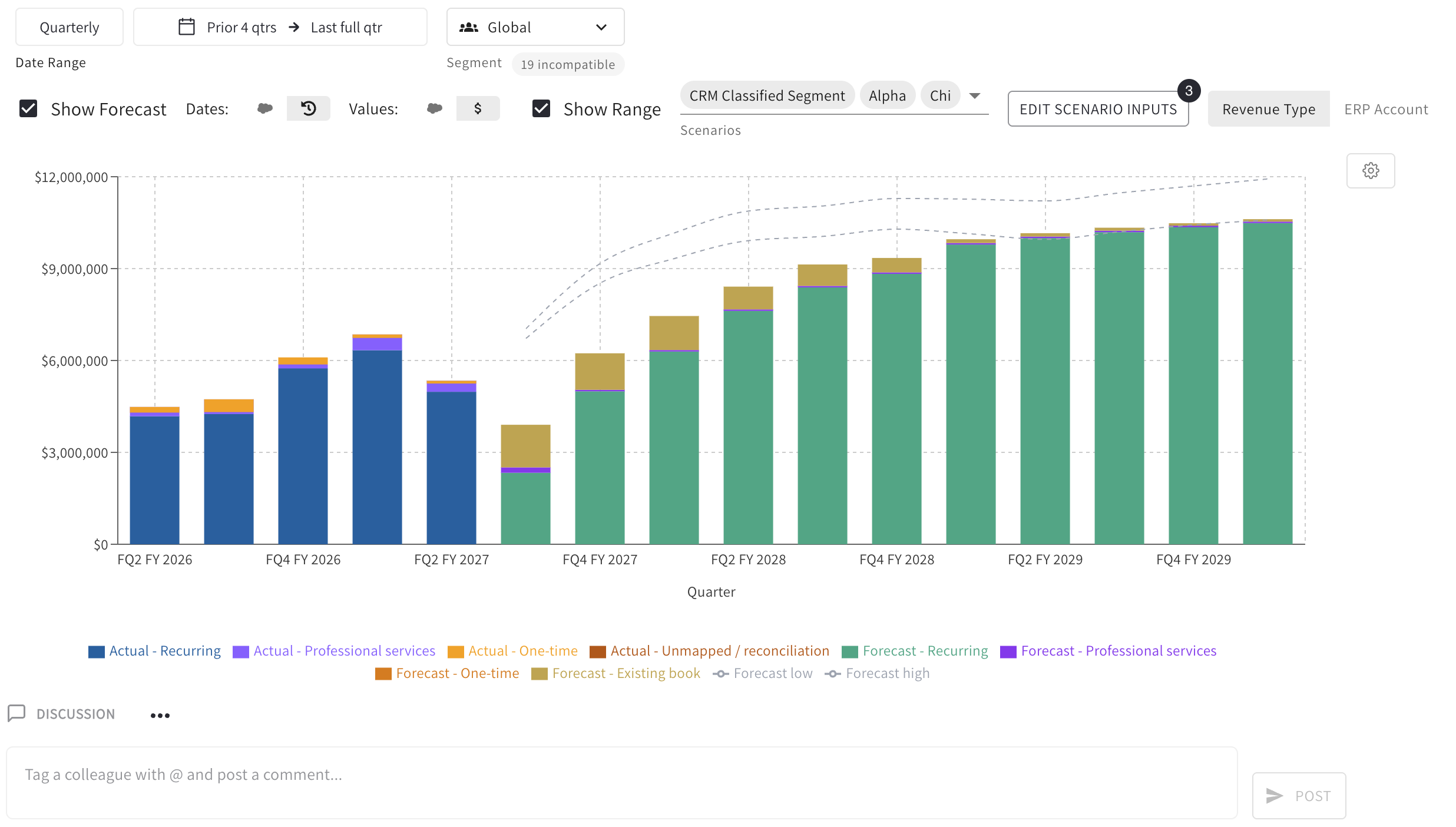
We’re pleased to announce that the QFlow Revenue Agent now models the full path. It forecasts bookings, translates them through the way each stream earns revenue, and replaces projections with accounting actuals as months close.
Forecast bookings first
Revenue does not begin with an isolated finance curve. It begins with the selling motion.
The Revenue Agent combines booked new business and expansion with known pipeline, qualified prospects, projected future demand, and the renewal cycles of existing and future customers. Each scenario keeps those sources distinct. A CRO can see how much depends on deals already in motion, how much comes from demand that has not reached opportunity stage, and how much assumes the business continues to create pipeline at its modeled pace.
The result is a forward bookings model tied to the data that produced it. The Revenue Agent then carries each booking into the revenue schedule instead of applying one recognition assumption to the total.
Model revenue the way you earn it
For a B2B subscription business, the Revenue Agent can recognize recurring revenue from ARR balances, contract terms, service dates, new bookings, expansions, and renewals. Existing-book recognition remains a separate layer, so revenue already under contract does not get counted again as future pipeline converts.
For a B2B2C or consumption business, the Revenue Agent can calculate usage revenue from estimated units, realization rate, and price per unit. Usage can remain flat or follow the expected profile of the contract.
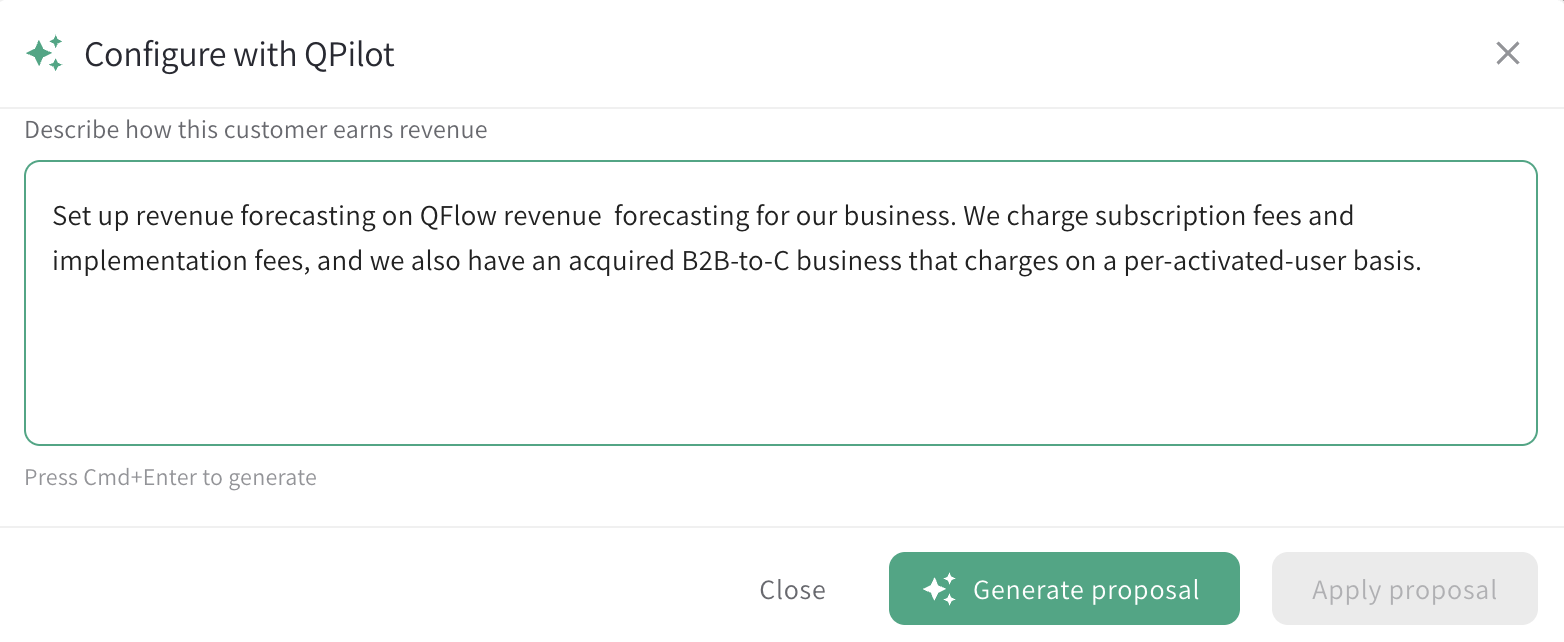
Hybrid businesses can combine those models with professional services, one-time or hardware revenue, and other streams. Each stream can draw from CRM opportunity fields, CPQ values, ARR projections, or explicit assumptions. Known deal values take precedence. Segment and company defaults fill the gaps. Recognition can run monthly, land in the same month, or spread in a straight line over a defined period.
Let accounting close the forecast
The forecast and the general ledger meet in the same revenue model. The Revenue Agent maps accounting income accounts into recurring, usage, professional services, one-time, and other revenue. Where needed, mappings can also distinguish departments or classes.
As a month closes, posted accounting revenue takes over from the projection. If the latest month is not fully posted, the Revenue Agent can carry forward existing-book recognition until the actuals arrive. The handoff corrects itself when accounting closes the period.
Unmapped income does not vanish. The Revenue Agent exposes it as reconciliation, preserving the top-line total while showing finance which source rows still need classification. The CFO can follow the transition from forecast to actual without accepting a hidden adjustment.
Carry the forecast into GTM economics
The CRO needs to know whether the selling motion can produce the bookings in the plan. The CFO needs to know when those bookings become revenue and what the growth costs. QFlow gives both leaders the same chain: demand, pipeline, bookings, recognition, and accounting actuals.
This forward-looking view sits beside go-to-market efficiency, so leadership can compare scenarios without separating the revenue plan from the economics used to judge it. Alignment still matters, but it follows from a model that reflects how the company sells, earns, and reports revenue.