
Call Recording Tools Do Not Provide Deep Win-Loss Analysis
They are valuable, but they are built around the conversation. They can summarize what a buyer said, identify an objection, and surface a moment from a call. They do not have the full opportunity, account, and contact history. They do not know how the deal moved through the funnel. And they cannot reliably connect qualitative evidence to finance-grade measures such as ARR.
A transcript is evidence. It is not, by itself, win-loss analysis.
QFlow’s Win-Loss Agent connects that evidence to the rest of the go-to-market record. It determines why deals were won or lost, measures how much revenue is attached to each reason, and lets leaders inspect the source material behind every conclusion.
The answer is not in one system
An executive asks why deals were lost last quarter. Most teams have two weak answers.
The first is a rollup of rep-selected pick list values: price, no decision, competitor, blank. It is fast and nearly useless. The second is a collection of call summaries from a conversation intelligence platform. It is richer, but still incomplete. The reason a deal was won or lost may sit in a discovery call, an email, a next-step field, a security note, a stage transition, or a change in the buying committee.
The Win-Loss Agent reads across the record:
- Structured CRM fields and pick lists
- Free-text notes, next steps, objections, and competitive context
- Opportunity, account, and contact activity, including emails
- Call summaries and transcripts from the active conversation system
- Stage movement and the stage immediately preceding the outcome
QFlow supports teams using Salesloft, Gong, Clari, or Zoom for conversation data. It resolves those records against the correct accounts and opportunities, combines them with CRM activity, and deduplicates overlapping call records before building the evidence set for each deal.
Win-Loss Agent reads the corpus
Closed deals leave evidence behind. The Win-Loss Agent reads the historical and live go-to-market corpus and classifies each closed deal against a consistent set of win and loss reasons.
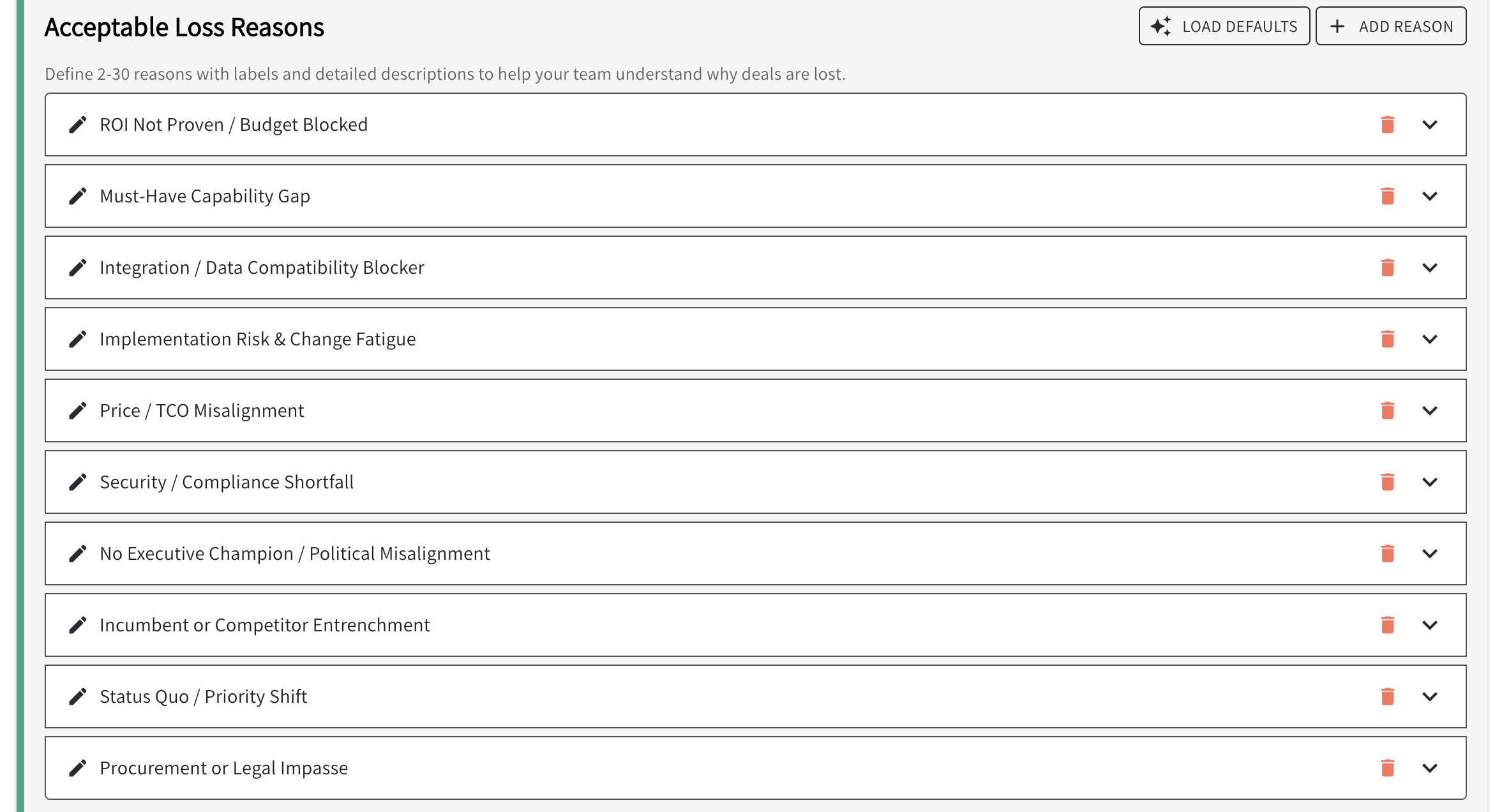
That taxonomy is configurable. RevOps can define the reasons that matter to the business and describe how each source should be interpreted. “Lost on integration” and “lost on implementation risk” may be one category for one company and two distinct operating problems for another. The Agent applies the same definitions across every opportunity, which turns inconsistent language into trends that can actually be counted.
It works backward and forward. The first pass analyzes the closed opportunities and historical evidence that already exist. Then the same analysis can be rerun as new wins, losses, activities, and conversations arrive.
Every conclusion is traceable
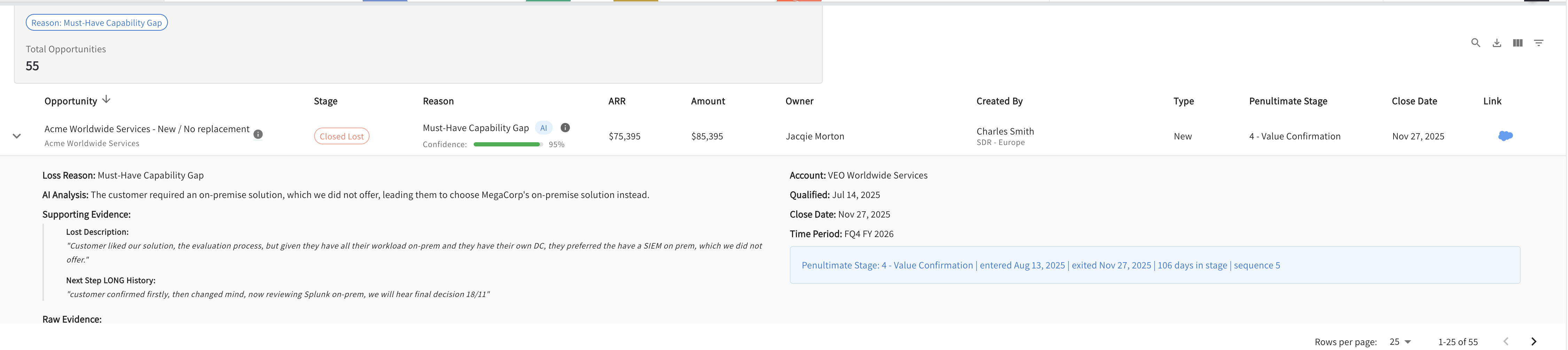
The Agent does not stop at a label. Each classification includes a confidence score and points back to the most important supporting evidence: the note, call summary, email, objection, requirement, number, or timeline that produced the result.
The evidence is deliberately specific. A capability gap should identify the missing capability. A pricing concern should include the number when one was stated. A stakeholder issue should identify the person and role when the data provides them. Leaders can expand an opportunity to inspect both the selected supporting evidence and the broader raw evidence supplied to the Agent.
If the evidence is contradictory or too thin, the answer is “Unable to Determine,” not a confident label invented to fill the cell. A trustworthy system should admit what it cannot see.
Conversation intelligence becomes an operating metric
This is where QFlow moves beyond call recording.
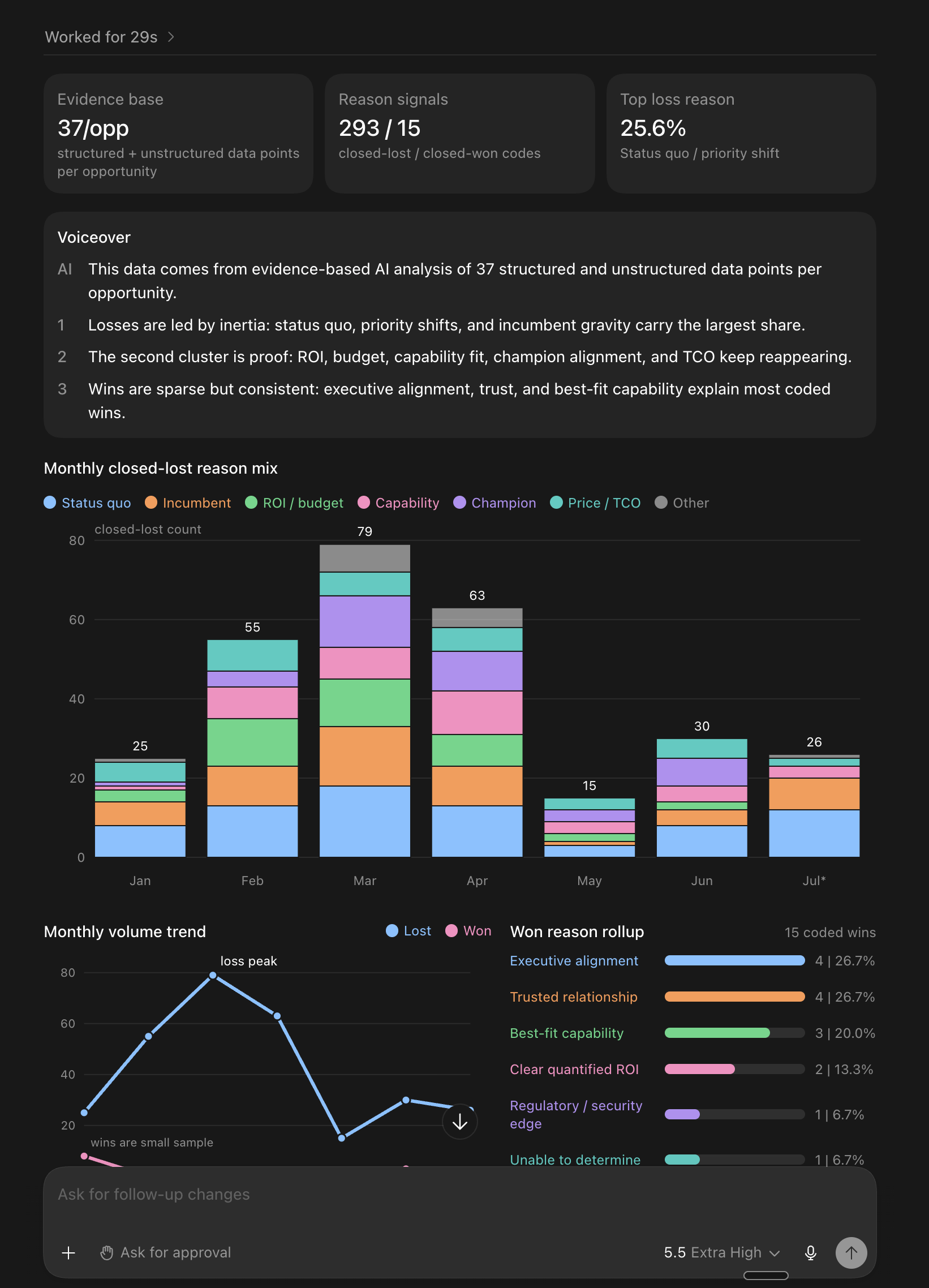
Win-loss reasons can be measured by opportunity count or ARR, tracked over time, and filtered by the operating dimensions already used to run the business. Leaders can compare segments, teams, deal types, quota groups, or stages; open a trend; and drill directly into the opportunities and evidence behind it.
A reason is no longer an isolated anecdote from a recording. It becomes a finance-connected metric with a numerator, a revenue value, a cohort, and an audit trail.
That changes the action. If security review is growing as an enterprise loss reason, product and sales leadership can inspect the affected ARR and the requirements buyers actually raised. If price pressure is concentrated in mid-market, the CRO can determine whether price is the real issue or a proxy for weak value. If “no decision” masks qualification problems, RevOps can change the process before the next board meeting.
A call recorder tells you what someone said.
QFlow’s Win-Loss Agent tells you why you are winning and losing, how much revenue is attached to each reason, where the pattern is concentrated, and exactly what evidence supports it.